Digital Scale Gives Different Readings: 10 Causes and Fixes
09
Sep
If your digital scale gives different readings within minutes, the scale is not automatically defective. The most common causes are a soft or uneven floor, moving the scale between measurements, low batteries, standing off-center, weighing at different times of day, or normal changes in body water and food weight.
Quick Fix: How to Get More Consistent Scale Readings
Place the scale on a hard, level floor—not carpet.
Keep it in the same location between measurements.
Check or replace weak batteries.
Let the scale reset to zero before stepping on.
Stand still in the center with weight distributed evenly.
Compare readings at the same time of day and under similar conditions.
If readings remain widely inconsistent, test the scale several times and review the manufacturer’s instructions.
If you are choosing a new model rather than troubleshooting an existing one, use our best scale for weighing yourself at home buying guide. This page focuses specifically on digital scale accuracy and inconsistent readings.
Bathroom scales measure force through internal sensors. Small changes in how the scale contacts the floor, how you stand, whether the scale has fully reset, and when you weigh yourself can change the displayed number. Some variation is also caused by your body rather than the device.
The useful question is not “Did the number change?” but “Does the scale produce reasonably consistent readings when the conditions are controlled?”
1. The Scale Is on Carpet or an Uneven Floor
A digital bathroom scale needs a hard, stable surface. Carpet, thick vinyl, uneven tiles, or a rocking floor can prevent all feet or sensors from loading evenly.
Fix: move the scale to a hard, level surface such as solid tile, stone, or wood. Once you find a stable position, leave it there for future comparisons.
2. You Move the Scale Before Every Measurement
Moving a scale can change how its feet contact the floor. Some digital models also need to re-zero after being picked up or shifted.
Fix: keep the scale in one location. If you must move it, place it firmly on a hard surface, allow it to initialize according to its instructions, and make sure the display returns to zero before weighing.
3. The Batteries Are Weak
Low battery power can cause display problems, failed startup, unstable behavior, or error messages on some digital scales.
Fix: replace the batteries with the correct type and orientation. Avoid mixing old and new batteries unless the manufacturer explicitly permits it.
4. You Step on Before the Scale Is Ready
Some scales use automatic step-on activation; others need a brief initialization. Stepping on too quickly after moving or resetting the scale can produce inconsistent results.
Fix: follow the model’s startup sequence and wait for a ready or zero indication when required.
5. You Stand Off-Center or Move During the Reading
Shifting your weight, leaning, touching a wall, or standing near the edge can change the load distribution across the sensors.
Fix: stand in the center, keep both feet flat, distribute weight evenly, and stay still until the value stabilizes.
6. You Compare Morning Weight With Evening Weight
Your body weight naturally changes during the day because of food, fluids, bathroom use, clothing, exercise, and water balance. A higher evening reading does not automatically mean the scale is inaccurate.
Fix: compare measurements taken under similar conditions. Many people find morning measurements after using the bathroom and before breakfast easier to standardize, but consistency matters more than chasing one “perfect” time.
7. Food, Fluids, Salt, and Water Retention Change Your Weight
Short-term weight changes can reflect water and digestive contents rather than a true change in body fat. A salty meal, a large amount of fluid, travel, exercise, or hormonal changes may alter scale weight temporarily.
Fix: focus on the trend across multiple days or weeks rather than reacting to one reading.
8. Clothing and Items in Your Pockets Are Different
Shoes, heavy clothing, a phone, keys, or other items can easily change the number enough to make repeated readings look inconsistent.
Fix: use similar clothing conditions when comparing measurements.
9. The Scale Has Not Been Reset After a Battery Change
Some models may require a reset or initialization after battery replacement or relocation. The procedure differs by manufacturer.
Fix: check the user manual for reset, calibration, or initialization instructions. Do not assume every digital scale uses the same procedure.
10. The Scale or Sensors May Be Damaged
If the scale rocks on a flat floor, shows errors repeatedly, has a cracked platform, damaged feet, battery corrosion, or produces large differences under identical conditions, the device may need service or replacement.
Fix: stop using a visibly damaged scale, review the warranty and service instructions, and avoid opening the device if that would create a safety risk or void the warranty.
How Much Difference Between Repeated Weighings Is Normal?
There is no single universal number that applies to every consumer scale because display resolution, maximum capacity, sensor design, and manufacturer specifications differ. A better test is repeatability:
Use the same hard floor.
Do not move the scale.
Measure within a short period.
Use the same person and stance.
Allow the scale to reset between readings.
If repeated values vary far more than the scale’s displayed increment or behave unpredictably, consult the model’s manual or service support.
How to Test a Digital Scale at Home
Step 1: Stabilize the Environment
Place the scale on a hard, level floor and do not move it during the test.
Step 2: Check Power
Use fresh batteries if the current batteries are old or the display is weak.
Step 3: Reset the Scale
Let the scale return to zero or complete its startup sequence as required by the manual.
Step 4: Repeat the Measurement
Take several readings using the same stance and conditions. Step off fully and allow the scale to reset each time.
Step 5: Compare the Pattern
Small variation may occur, but large or random changes under tightly controlled conditions suggest a setup or device problem worth investigating.
Can You Test a Scale With a Known Weight?
A known, stable object can sometimes help identify obvious problems, but household objects are not certified calibration weights, and many bathroom scales are designed primarily for a person standing across the platform. Use any home test only as a basic consistency check, not as formal calibration.
Does a More Expensive Scale Mean Better Accuracy?
Not necessarily. Price can reflect design, materials, connectivity, body-composition estimates, app features, or brand positioning. For basic weight tracking, stable repeatability, suitable capacity, a clear display, and correct use are often more important than extra features.
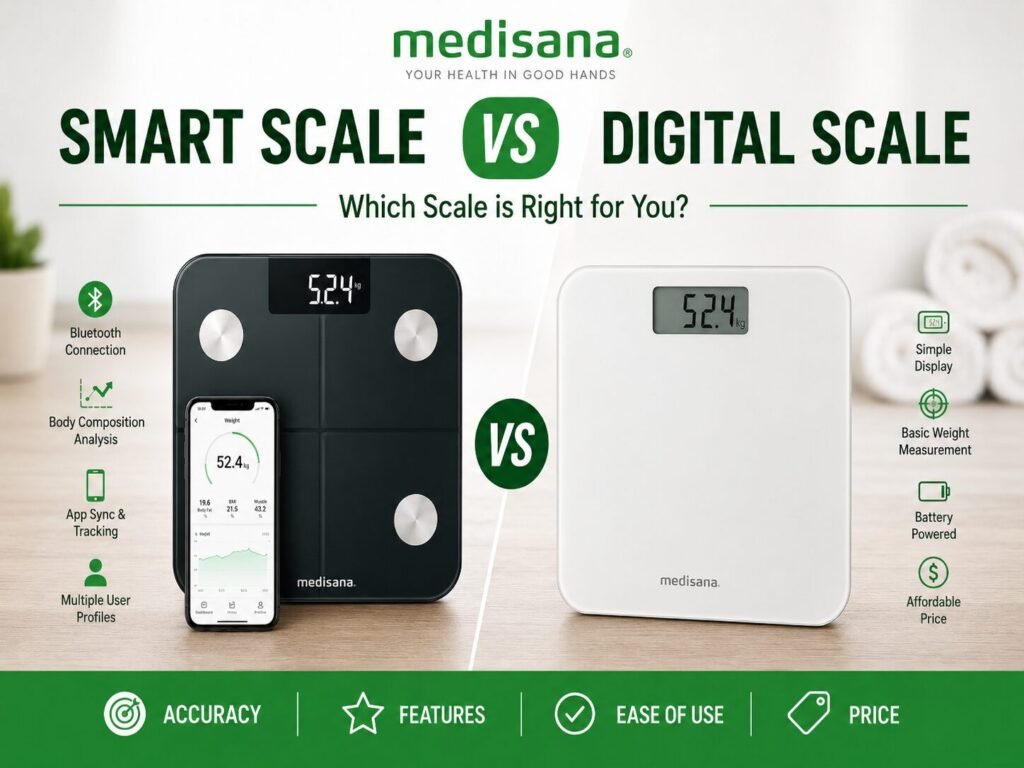
Digital Scale vs. Smart Body Composition Scale
A standard digital scale measures body weight. A smart body composition scale may also estimate body fat, muscle, water, or other values using bioelectrical impedance. These additional values are estimates and can vary with hydration and measurement conditions.
If your main goal is weight tracking, a simple digital scale can be enough. If you want trend data from estimated body-composition metrics, a smart scale may be useful when interpreted consistently.
When Should You Replace a Digital Scale?
Consider replacement or service when:
The platform or housing is cracked.
The scale rocks despite being on a level floor.
Battery contacts are corroded or damaged.
The display fails repeatedly.
Error codes continue after basic troubleshooting.
Readings remain highly inconsistent under identical conditions.
The required weight capacity no longer suits the user.
Why does my scale show a different weight every time?
The most common reasons are an unstable floor, moving the scale, weak batteries, standing differently, or not allowing the scale to reset. Body weight can also change naturally during the day.
Should I weigh myself twice?
You can repeat a reading if you suspect a setup error. For regular tracking, consistency over time matters more than repeatedly weighing until you get a preferred number.
Is carpet bad for a digital scale?
Yes, a soft surface can reduce stability and interfere with how the scale loads its sensors. Use a hard, level floor unless the manufacturer provides a specific carpet accessory.
Why is my morning weight lower than my evening weight?
Food, fluids, clothing, and normal daily changes often make evening weight higher. Compare readings taken under similar conditions.
Does a smart scale need calibration?
Initialization and reset procedures vary by model. Follow the manufacturer’s manual rather than using a generic calibration method.
Conclusion
When a digital scale gives different readings, start with the environment and technique before assuming the device is faulty. A hard level floor, fixed location, fresh batteries, correct reset sequence, centered stance, and consistent measurement timing solve many common problems. If large differences continue under controlled conditions, review the manufacturer’s troubleshooting instructions or service options.
Shop from WeCare Egypt
Explore Trusted Home Medical Devices and Medical Supplies
Compare blood pressure monitors, inhalation devices, weight scales, massage devices, and home health care products, then choose the most suitable option for your daily needs from WeCare Egypt.
Nebulizer not making mist? Troubleshoot compressor and mesh models by checking power, tubing, filter, cup assembly, batteries, mesh contact and cleaning—without changing the medication dose.
Learn why a pulse oximeter may show low or unstable SpO₂, how to repeat the measurement correctly, common accuracy limitations, and when symptoms need medical attention.
Learn what Perfusion Index (PI) means on a pulse oximeter, how it differs from SpO₂ and pulse rate, why PI changes, and how to use it as a signal-quality clue.
Understand LO, HI, ERR, E1, E2 and battery symbols on digital thermometers, what they may mean, and the correct troubleshooting order before requesting support.
Learn how to use a digital contact thermometer correctly for armpit or oral measurement, read the result, clean the probe and handle LO, HI or ERR safely.
Learn how to measure temperature under the armpit correctly, where to place the thermometer, why you should not automatically add a degree, and when to confirm a reading.
Understand normal body temperature by age, time of day and measurement site, including what 36°C, 37°C, 37.5°C and 38°C can mean and when symptoms matter more than the number.
Thermometer readings different at home? Check measurement site, timing, Body mode, probe contact, forehead distance, sweat, battery and repeat technique before blaming the device.
Compare Medisana TM 700, TM 750 Connect and TM 760 for children by age, measurement site, contact vs no-contact use, memory, Bluetooth and sleep-time convenience.
High blood pressure usually causes no symptoms. Learn what headache, dizziness or blurred vision can and cannot tell you, and when a reading above 180/120 with symptoms is an emergency.