

Blog
Looking for a scale you can buy now? Compare Medisana personal scales currently available in Egypt by capacity, platform size, price and stock.
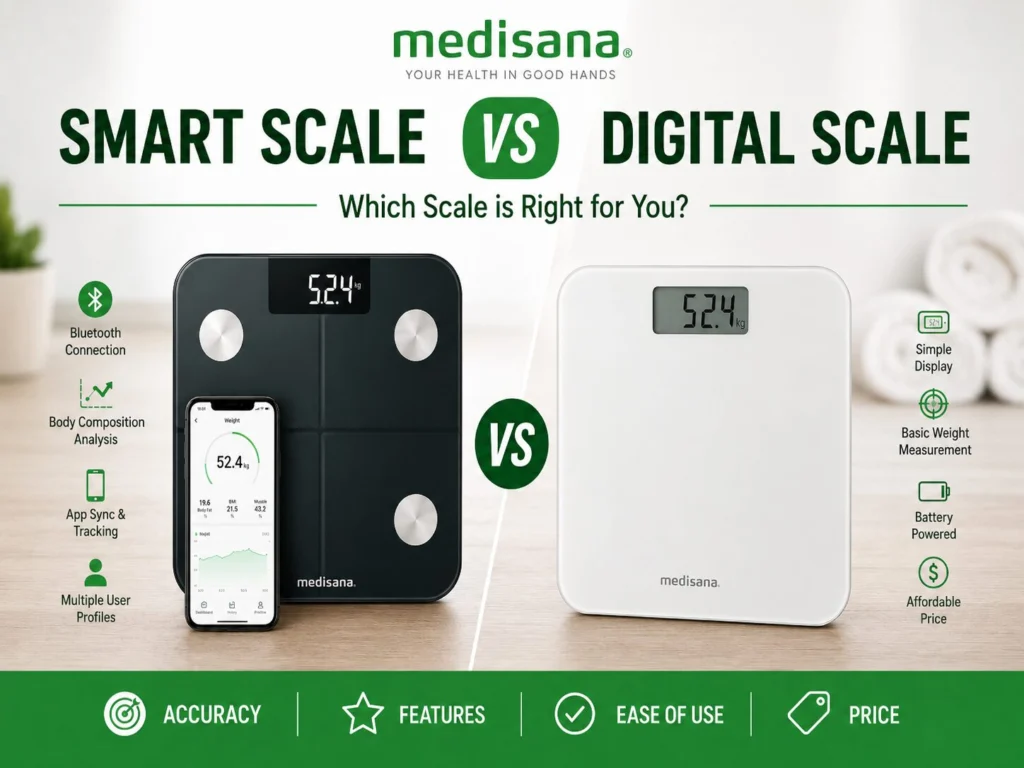
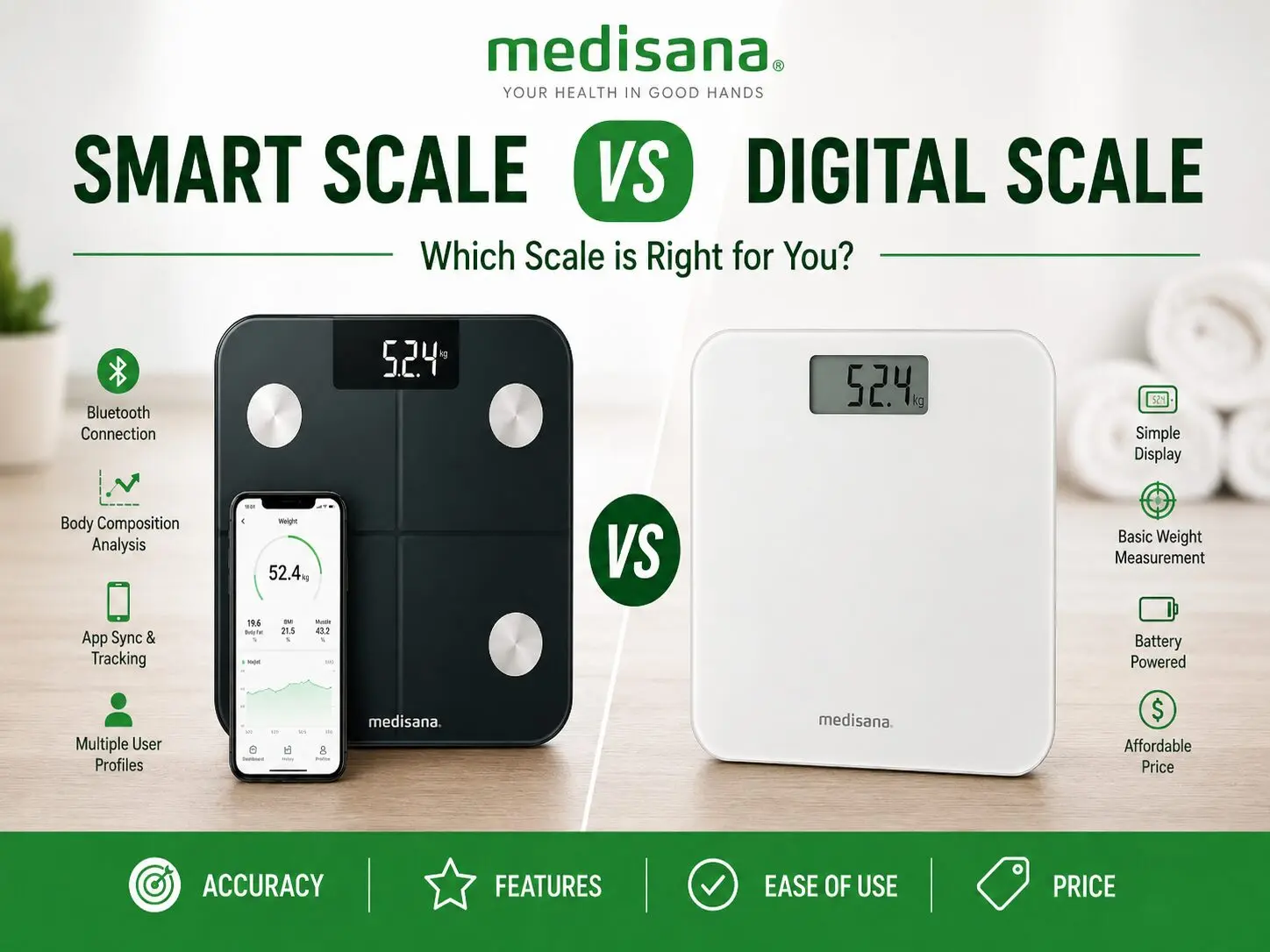
Understanding the difference between a smart scale vs digital scale involves more than checking whether the device connects to a smartphone or displays additional numbers. A standard digital weight scale is primarily designed to measure body weight and display the result immediately, while a smart scale may save measurements, track weight changes, connect to a mobile application, and estimate selected body composition indicators.
سنتحدث فى هذا المقال عن!
ToggleWhen comparing a smart scale vs digital scale, there is no single option that is automatically better for every user. A reliable digital bathroom scale may be the most practical choice when you simply want a fast and clear weight reading. However, a smart scale with app connectivity may be more useful when you are following a diet, managing a fitness program, or monitoring long-term changes in weight, body fat, muscle mass, and other estimated measurements.
This detailed guide explains the difference between smart and digital scale models in terms of accuracy, weight measurement, body fat analysis, app connectivity, ease of use, price, privacy, and long-term tracking. It will also help you determine the best scale for weight tracking based on your actual needs rather than the number of advertised features.
Smart Scale vs Digital Scale: What Is the Main Difference?
The main difference in the smart scale vs digital scale comparison is the way each device handles your measurements.
A digital scale, sometimes called an electronic scale, digital bathroom scale, or digital weight scale, measures body weight and displays the result on its built-in screen. Most digital scales work independently without requiring a smartphone, an internet connection, or a user account.
A smart scale performs the same basic weight measurement but adds connected features. A smart scale with app support may transfer measurements to your smartphone through Bluetooth or Wi-Fi, store your weight history, display progress charts, and create separate profiles for multiple users.
A smart body composition scale may also estimate measurements such as body fat percentage, body water, muscle mass, bone mass, visceral fat, body mass index, and basal metabolic rate. These additional readings make it different from a standard digital scale, although they should normally be treated as estimates rather than medical results.
| Comparison Point | Digital Scale | Smart Scale |
|---|---|---|
| Measures body weight | Yes | Yes |
| Displays weight on a built-in screen | Yes | Yes |
| Works without a smartphone | Yes | Usually displays weight without a phone |
| Connects to a mobile application | Usually unavailable | Available depending on the model |
| Saves weight history | Limited or unavailable | Usually available through the app |
| Provides progress charts | Usually unavailable | Common on connected models |
| Estimates body fat percentage | Not normally available | Available on body composition models |
| Estimates water and muscle mass | Usually unavailable | Available depending on the model |
| Supports multiple user profiles | Depends on the device | Common in smart scale applications |
| Initial setup | Very simple | May require account and app setup |
| Typical price | Usually lower | Usually higher |
| Best suited for | Simple body weight measurement | Long-term weight and body composition tracking |
What Is a Digital Weight Scale?
A digital weight scale is an electronic device that uses built-in sensors to measure body weight. The sensors detect the pressure applied to the weighing platform and convert it into a numerical result displayed on the screen.
Most digital scales switch on automatically when you step onto them. Unlike a smart scale with app connectivity, a traditional digital model does not normally require registration, Bluetooth pairing, Wi-Fi access, or personal information.
The design of a digital bathroom scale can vary considerably. Important differences may include:
- The quality and sensitivity of the weight sensors.
- The maximum supported weight.
- The measurement increments.
- The size and stability of the weighing platform.
- The clarity and brightness of the display.
- The availability of kilogram, pound, and stone units.
- The presence of automatic activation and shutdown.
- The type and expected life of the batteries.
A digital scale may be suitable when:
- You only need to measure body weight.
- You prefer a simple device that works immediately.
- You do not need charts or stored measurements.
- You do not want to connect the scale to a phone.
- You want a clear display that is easy for the whole family to read.
- You need a practical scale for older adults.
- You prefer a lower purchase price.
- You do not want to create an account or share personal data with an application.
The simplicity of a digital weight scale should not be viewed as a disadvantage. For many households, consistent weight readings, a stable platform, a clear screen, and straightforward operation are more important than body composition estimates that may not be used regularly.
For a broader comparison of the specifications that matter before purchasing, read our complete guide to choosing the best scale for weighing yourself at home.
What Is a Smart Scale?
A smart scale is a digital weighing device that includes connectivity and data-tracking features. A typical smart scale with app functionality can synchronize readings with a smartphone through Bluetooth or Wi-Fi.
Once connected, the application may record each measurement, organize results by date, display weekly or monthly trends, and help users compare current results with previous readings.
Some smart scale applications can also:
- Create separate profiles for different family members.
- Recognize users automatically based on weight patterns.
- Display weight changes through charts and graphs.
- Calculate body mass index based on height and weight.
- Synchronize data with selected health or fitness applications.
- Set weight goals and show progress toward them.
- Export or share measurement history.
- Display estimated body composition measurements.
However, not every smart scale provides the same features. Some devices are simply connected weight scales, while others operate as a smart body composition scale or body fat scale with additional analysis capabilities.
What Does a Smart Body Composition Scale Measure?
A smart body composition scale measures body weight directly and may estimate several additional indicators. Depending on the model and application, these indicators can include:
- Body fat percentage.
- Body water percentage.
- Muscle mass.
- Bone mass.
- Body mass index.
- Basal metabolic rate.
- Visceral fat level.
- Protein percentage on selected models.
- Estimated metabolic age on selected applications.
Most consumer body composition scales use bioelectrical impedance analysis, commonly known as BIA. When you stand barefoot on the conductive electrodes, the scale sends a very low electrical current through the body and analyzes the resistance encountered.
The device combines this information with personal details such as age, height, sex, and sometimes activity level to estimate body composition.
This means that a body fat scale does not measure body fat in the same direct way that it measures body weight. Weight is detected by the scale’s load sensors, while body fat, water, muscle, and bone measurements are calculated estimates.
For this reason, readings from a smart body composition scale are generally more useful for monitoring patterns over time than for interpreting one isolated measurement. They should not be treated as a medical diagnosis or a replacement for professional body composition testing.
Difference Between Smart and Digital Scale Measurements
The difference between smart and digital scale measurements becomes clear when you compare the amount of information provided and how that information is stored.
Body Weight Measurement
Both a smart scale and a digital weight scale can measure body weight. A smart scale is not automatically more accurate simply because it connects to a mobile application.
Weight measurement depends mainly on:
- The quality of the internal sensors.
- The construction and stability of the platform.
- The surface on which the scale is placed.
- The user’s standing position.
- Correct calibration.
- Battery condition.
- Using the scale under consistent conditions.
Therefore, a well-designed digital bathroom scale may provide more consistent weight readings than a low-quality connected scale.
For example, the Medisana PS400 Digital Personal Scale is designed for straightforward home weight tracking with a clear screen, automatic activation, and a stable tempered-glass platform.
Body Fat Measurement
A standard digital scale usually measures body weight only. A body fat scale may estimate body fat percentage using BIA technology.
Body fat estimates can be affected by:
- Hydration levels.
- Food and drink consumption.
- Recent exercise.
- Skin temperature.
- Time of day.
- Foot contact with the electrodes.
- The personal information entered into the application.
For more meaningful comparisons, use your body fat scale at approximately the same time and under similar conditions whenever possible.
Weight History and Progress Tracking
A traditional digital scale displays the current reading. Some advanced models may store a limited number of previous readings, but most do not create detailed progress records.
A smart scale with app synchronization can automatically store measurements and display them as a timeline or graph. This allows you to monitor whether your weight is increasing, decreasing, or remaining stable over several weeks or months.
This tracking function is one reason a connected model may be considered the best scale for weight tracking for users who regularly follow structured diet or fitness programs.
Smart Scale Accuracy vs Digital Scale Accuracy
Smart scale accuracy should be evaluated in two separate areas:
- The accuracy and consistency of body weight measurement.
- The reliability of estimated body composition data.
The same distinction applies when evaluating a digital scale. The product category alone does not determine accuracy. Sensor quality, manufacturing standards, setup, and usage conditions are usually more important than whether the scale is labeled digital or smart.
Accuracy of Body Weight Measurements
A high-quality smart or digital scale should provide similar readings when you weigh yourself repeatedly under the same conditions. Small differences can occur, but large or unpredictable changes may indicate an uneven floor, weak batteries, movement during measurement, or a need to recalibrate the device.
To improve measurement consistency:
- Place the scale on a hard and level surface.
- Avoid using the scale on thick carpet.
- Keep the scale in the same location.
- Stand in the center of the platform.
- Distribute your weight evenly between both feet.
- Remain still until the reading is complete.
- Use the scale at a similar time each day or week.
- Replace weak batteries promptly.
- Follow the manufacturer’s calibration instructions.
You can review our guide to choosing the best weight scale in Egypt to understand how sensor quality, platform design, display clarity, and warranty can affect the overall weighing experience.
Smart Scale Accuracy for Body Fat
When users ask about smart scale accuracy, they are often referring to body fat and muscle measurements rather than body weight.
A smart scale can provide a useful weight reading when used correctly. However, estimates from a smart body composition scale are more likely to fluctuate because BIA measurements can be influenced by hydration and other temporary conditions.
For example, a body fat reading may change after drinking a large amount of water, eating a meal, completing a workout, or measuring at a different time of day.
This does not necessarily mean that the scale is defective. It means that body composition measurements should be compared under similar conditions and interpreted as long-term trends.
Can a Digital Scale Be More Accurate Than a Smart Scale?
Yes. A high-quality digital bathroom scale can be more consistent than a poorly manufactured smart scale. Smartphone connectivity does not improve the physical weight sensors inside the product.
Likewise, a reputable smart scale may provide consistent body weight measurements while offering more convenient tracking tools. The better choice depends on the quality of the specific model rather than the category alone.
Smart Scale vs Digital Scale for Weight Loss
When choosing a smart scale vs digital scale for weight loss, consider how much information helps you remain consistent without creating unnecessary confusion.
A digital scale can be completely sufficient if you:
- Record your weight manually.
- Use a notebook or spreadsheet.
- Only need weekly measurements.
- Prefer to focus on overall weight trends.
- Do not need estimated body composition data.
A smart scale may be more helpful if you:
- Want measurements saved automatically.
- Prefer visual progress charts.
- Track several indicators over time.
- Share the scale with multiple users.
- Already use compatible health or fitness applications.
- Find automatic records more motivating than manual tracking.
For some users, a smart scale with app connectivity may be the best scale for weight tracking because it reduces the need to record every measurement manually. For others, a simple digital scale provides all the information required.
Smart Scale vs Digital Scale for Fitness and Muscle Tracking
A smart body composition scale may appear more suitable for athletes and fitness users because it can estimate muscle mass, body fat, and body water.
However, these readings should be interpreted carefully. Changes in hydration after exercise can affect estimated muscle and fat results. You should therefore avoid treating every short-term change as a genuine increase in muscle or loss of fat.
A more practical approach is to:
- Measure under similar conditions.
- Review changes over several weeks.
- Use the same scale consistently.
- Combine scale data with waist measurements and fitness performance.
- Avoid comparing readings from different scale brands or technologies.
A body fat scale can support a fitness routine, but it should not be the only method used to evaluate progress.
Which Is the Best Scale for Weight Tracking?
The best scale for weight tracking depends on whether you prefer automatic or manual record keeping.
A smart scale may be the better weight-tracking option when:
- You weigh yourself regularly.
- You want every result saved automatically.
- You prefer charts instead of handwritten records.
- You want separate profiles for family members.
- You already use a health application.
- You need progress summaries.
A digital scale may be the better option when:
- You only weigh yourself occasionally.
- You prefer simple operation.
- You do not want to install an application.
- You do not need automatic history.
- You want a lower-cost and easy-to-maintain device.
The best scale for weight tracking is not necessarily the model with the largest number of measurements. It is the scale that produces consistent readings and fits naturally into your routine.
If you prefer a straightforward model with a modern design, you can compare the Medisana PS402 Black Digital Personal Scale, which focuses on direct weight measurement, a clear LCD display, and easy automatic operation.
Smart Scale With App: Benefits and Limitations
A smart scale with app support can make long-term weight monitoring easier, but the quality of the application matters as much as the scale itself.
Benefits of a Smart Scale With App Connectivity
- Automatic measurement storage.
- Weekly, monthly, and yearly progress charts.
- Separate user profiles.
- Goal-setting tools.
- Body composition history.
- Integration with selected fitness platforms.
- Reduced need for manual record keeping.
- Easier comparison of long-term trends.
Potential Limitations
- The initial pairing process may take time.
- Some functions may require account registration.
- Application compatibility can vary between operating systems.
- The application may stop receiving future updates.
- Some features may depend on an internet connection.
- Personal measurement data may be stored online.
- Synchronization may occasionally fail.
- Different family members may need separate setup steps.
Before purchasing a smart scale with app connectivity, check application reviews, smartphone compatibility, available privacy controls, and whether data can be deleted or exported.
How to Choose Between a Smart Scale and a Digital Scale
1. Identify the Measurements You Actually Need
Start by deciding whether you only need body weight or also want estimated body composition data.
If you only need a clear weight reading, a digital weight scale may be sufficient. If you want automatic history, progress charts, and body composition estimates, consider a connected smart model.
2. Check the Maximum Weight Capacity
Review the maximum weight supported by the scale and make sure it is suitable for all intended users. Select a model that provides an appropriate safety margin and never exceed the manufacturer’s stated limit.
Users who need a larger platform and higher weight capacity can review the Medisana PS470 Large Digital Personal Scale. Its wider standing surface makes it a practical option for users who value additional platform space and stability.
3. Review the Measurement Increment
The measurement increment indicates the smallest weight change displayed by the scale. A smaller increment may provide more detailed readings, but it does not automatically guarantee better overall accuracy.
4. Consider Platform Size and Stability
A wide, stable platform can make the scale easier and safer to use. This is particularly important for older adults, users with larger feet, and anyone who may find balance difficult.
A high-quality digital bathroom scale should have a solid platform and a non-slip base where appropriate.
5. Choose a Clear Display
Whether you buy a smart scale vs digital scale, the built-in display should be easy to read. Look for large numbers, good contrast, sufficient brightness, and a viewing angle that does not require excessive bending.
For older adults, users with limited vision, or anyone who prefers audible results, the Medisana PS425 Talking Digital Personal Scale provides spoken weight readings alongside its digital display.
6. Review Application Compatibility
When considering a smart scale with app connectivity, confirm that the application supports your smartphone and operating system.
Review:
- Android and iOS compatibility.
- Bluetooth or Wi-Fi requirements.
- The account registration process.
- Multi-user support.
- Data synchronization speed.
- Application update history.
- Language options.
- Privacy and data deletion controls.
- Integration with other health applications.
7. Check Battery Type and Availability
Review the required batteries and how easily they can be replaced. Weak batteries may lead to display problems, failed synchronization, or inconsistent readings.
8. Consider Privacy
A digital scale usually stores little or no personal information. A smart scale may collect weight records, age, height, body composition estimates, account details, and usage information.
Read the application’s privacy settings and understand where your data is stored before creating an account.
9. Review Warranty and After-Sales Support
Choose a scale with a clear warranty and reliable technical support. Warranty coverage, replacement availability, and access to authorized service may be more valuable than an extensive list of rarely used features.
10. Avoid Paying for Unnecessary Features
A smart body composition scale may display many indicators, but additional measurements only provide value when you understand and use them consistently.
If your main goal is to check your weight, a reliable digital weight scale may offer a simpler and more practical experience.
How to Use a Smart or Digital Scale Correctly
Correct use can improve the consistency of measurements, regardless of which option you select in the smart scale vs digital scale comparison.
- Place the scale on a hard, dry, and level surface.
- Do not use it on thick carpet unless the manufacturer specifically allows it.
- Keep the scale in the same location whenever possible.
- Stand barefoot if body composition measurements are required.
- Place both feet in the correct position.
- Stand upright and remain still.
- Wait for the final reading before stepping off.
- Measure at a similar time and under similar conditions.
- Avoid comparing a morning reading with one taken after a large meal.
- Follow the calibration and startup instructions provided with the scale.
- Replace weak batteries when needed.
- Review long-term trends instead of focusing on one daily fluctuation.
For practical operating, placement, battery, and cleaning instructions, you can review the Medisana PS440 scale user manual.
If you use the larger-capacity model, read the Medisana PS470 user manual for model-specific setup and usage guidance.
When Is the Best Time to Weigh Yourself?
Consistency is more important than choosing a perfect time. Many users prefer to weigh themselves in the morning, after using the bathroom and before eating or drinking large amounts of fluid.
Using your digital bathroom scale under similar conditions makes it easier to compare readings fairly. Avoid comparing a morning measurement with an evening measurement or a reading taken directly after a large meal.
You should also avoid interpreting every small daily change as real fat gain or loss. Body weight can fluctuate because of food, water, salt intake, digestion, exercise, and other temporary factors.
How Often Should You Weigh Yourself?
The appropriate weighing frequency depends on your goals and how you respond to normal fluctuations.
Daily Weighing
Daily weighing may suit users who prefer detailed tracking, provided they focus on weekly averages and long-term trends rather than reacting to every reading.
Several Times per Week
This provides regular information while reducing excessive attention to normal daily changes.
Once per Week
A weekly measurement can be a practical option for users who want to monitor medium-term progress without weighing themselves every day.
Once or Twice per Month
This may be suitable for people who are maintaining their weight and do not need close monitoring.
A smart scale with app support can make frequent tracking easier by storing each reading automatically. A regular digital scale can provide the same weight information, but you may need to record it manually.
Common Mistakes That Reduce Scale Accuracy
Placing the Scale on Carpet
A soft or uneven surface can prevent the scale from sitting correctly and may cause inconsistent measurements. Place the device on hard flooring unless the manufacturer provides special carpet feet.
Moving the Scale Between Measurements
Different floor surfaces can produce different results. Keep your scale in one suitable location whenever possible.
Standing in the Wrong Position
Standing near the edge, shifting your weight, or moving during measurement can affect the result. Stand in the center and distribute your weight evenly.
Comparing Measurements Taken at Different Times
Body weight naturally changes throughout the day because of food, water, clothing, and physical activity. Compare measurements taken under similar conditions.
Assuming Every Body Fat Change Is Real
A body fat scale may show short-term changes caused by hydration rather than actual changes in body fat. Monitor the general direction over several weeks.
Assuming More Indicators Mean Better Accuracy
A scale that displays 15 or 20 measurements is not automatically more accurate than a simpler model. Focus on sensor quality, consistency, usability, and warranty.
Choosing a Scale Based Only on Its Application
A well-designed application is helpful, but it cannot compensate for weak sensors, an unstable platform, a poor display, or unreliable construction.
Ignoring Weak Batteries
Weak batteries may affect activation, display brightness, connectivity, and reading consistency. Replace them according to the manufacturer’s recommendations.
Focusing on One Reading
A single measurement does not show the complete direction of your progress. Use your scale to monitor a trend over time rather than treating one reading as a final result.
Advantages and Disadvantages of a Digital Bathroom Scale
Advantages of a Digital Scale
- Simple and fast operation.
- No application or account required.
- Usually more affordable.
- Suitable for users who only need body weight.
- Easy for different family members to share.
- Limited collection of personal data.
- Often suitable for older users.
- Clear readings on a built-in display.
Disadvantages of a Digital Scale
- Usually does not store detailed measurement history.
- Does not normally provide progress charts.
- Limited or no body composition information.
- Measurements may need to be recorded manually.
- May not integrate with fitness applications.
Advantages and Disadvantages of a Smart Body Composition Scale
Advantages of a Smart Scale
- Automatic measurement history.
- Weight trends and progress charts.
- Multiple user profiles.
- Estimated body fat and muscle measurements.
- Potential integration with fitness applications.
- Convenient long-term tracking.
- Useful for structured diet and fitness routines.
Disadvantages of a Smart Scale
- Usually costs more than a standard digital scale.
- Requires an initial application setup.
- Some functions may require internet access.
- Body composition readings are estimates.
- Results can be influenced by hydration.
- Application compatibility may change.
- Users should review data privacy practices.
Smart Scale vs Digital Scale: Which One Should You Choose?
Choose a digital bathroom scale when:
- Your main objective is measuring body weight.
- You prefer straightforward operation.
- You want a device suitable for all family members.
- You do not need stored records or charts.
- You do not want smartphone connectivity.
- You prefer a lower price.
- You do not want to create an account.
- You prefer to record results manually.
Choose a smart scale with app support when:
- You want measurements saved automatically.
- You follow a structured diet or fitness plan.
- You want to view long-term progress charts.
- You need profiles for multiple users.
- You want estimated body composition measurements.
- You understand the limitations of BIA readings.
- You already use compatible health applications.
- You value convenience and automatic synchronization.
The final smart scale vs digital scale decision should be based on your routine, not marketing language. A simple scale that you use consistently may be more valuable than an advanced model whose features you rarely use.
Frequently Asked Questions About Smart Scale vs Digital Scale
What Is the Difference Between Smart and Digital Scale Models?
The main difference between smart and digital scale models is connectivity and data management. A digital scale measures body weight and displays the result, while a smart scale may connect to an application, store measurements, provide progress charts, support several users, and estimate body composition.
Which Is Better: Smart Scale vs Digital Scale?
The better choice depends on your needs. A digital scale is suitable for simple weight measurement, while a smart scale is more suitable for users who need automatic records, charts, and estimated body composition data.
Which Is More Accurate: A Smart Scale or a Digital Scale?
Neither category is automatically more accurate. Weight measurement depends on the quality of the sensors, device stability, calibration, battery condition, floor surface, and correct use.
What Determines Smart Scale Accuracy?
Smart scale accuracy for body weight depends mainly on sensor and manufacturing quality. Body composition estimates can also be affected by hydration, food intake, activity, measurement time, and the personal information entered into the application.
Is a Digital Bathroom Scale Accurate?
A high-quality digital bathroom scale can provide consistent body weight readings when it is placed on a hard, level surface and used correctly.
What Is a Digital Weight Scale Used For?
A digital weight scale is primarily used to measure body weight and display the result electronically. Some advanced digital models may include limited memory, but they do not necessarily provide smartphone connectivity.
What Is a Smart Body Composition Scale?
A smart body composition scale is a connected scale that measures weight and estimates body fat, body water, muscle mass, and other indicators depending on the model.
Is a Body Fat Scale Accurate?
A body fat scale can help monitor general trends, but its readings are estimates and may change according to hydration, food intake, exercise, and measurement conditions.
Does a Smart Scale With App Connectivity Need Internet Access?
It depends on the model. A Bluetooth smart scale with app support may synchronize directly with a nearby smartphone, while Wi-Fi scales and some application features may require internet access.
Can a Smart Scale Work Without a Phone?
Many smart scales can display body weight without opening the application. However, measurement history, detailed body composition results, and progress charts may require smartphone synchronization.
Which Is the Best Scale for Weight Tracking?
The best scale for weight tracking is one that provides consistent readings and fits your routine. A smart scale is often more convenient for automatic tracking, while a digital scale is suitable when you are comfortable recording measurements manually.
Can a Digital Scale Measure Body Fat?
A standard digital scale normally measures body weight only. However, some digital models are also designed as body composition scales. Always review the product specifications instead of relying only on the product name.
Can Several People Use the Same Smart Scale?
Many smart scales support multiple user profiles, although the number of users and the identification method vary between models. Check the application specifications before purchasing.
Is a Smart Scale Worth the Additional Cost?
A smart scale may be worth the higher price when you regularly use its automatic history, progress charts, user profiles, and body composition estimates. If you only need a weight reading, a digital scale may provide better value.
Which Scale Is Easier for Older Adults?
A digital scale with a large screen, wide platform, and automatic activation is often easier for older adults. A talking digital scale may also help users who have difficulty reading the screen. A smart scale can still be useful when another family member manages the application.
How Often Should I Use a Smart or Digital Scale?
The appropriate frequency depends on your goal and how you respond to daily fluctuations. Some people prefer daily measurements and weekly averages, while others find one or two consistent weekly measurements more useful.
Conclusion: Smart Scale vs Digital Scale
The smart scale vs digital scale comparison is mainly about how much information you need and how you prefer to manage it.
A digital weight scale or digital bathroom scale is a practical choice when you want a simple, fast, and clear body weight reading without applications, accounts, or additional setup.
A smart scale with app connectivity may be more suitable when you want automatic measurement history, progress charts, several user profiles, and estimated body composition data.
A smart body composition scale or body fat scale can help you monitor changes in weight, body fat, water, and muscle mass over time. However, body composition results should be treated as estimates rather than medical diagnoses.
When deciding between a smart scale vs digital scale, do not choose a model only because it displays more measurements. Look for reliable sensors, a stable platform, a clear screen, an appropriate maximum weight capacity, easy operation, application compatibility where needed, and an official warranty.
The best scale for weight tracking is ultimately the device you can use consistently and correctly. Select the features that support your goals and avoid paying for functions that you are unlikely to use.
You can browse the complete Medisana personal scales collection and compare the available English product pages based on platform size, display clarity, maximum weight capacity, design, ease of use, and the features that match your daily weight-tracking needs.
Ready to compare available models? Browse Medisana personal scales currently available in Egypt and check each model’s current price, capacity and stock before ordering.
Explore Trusted Home Medical Devices and Medical Supplies
Compare blood pressure monitors, inhalation devices, weight scales, massage devices, and home health care products, then choose the most suitable option for your daily needs from WeCare Egypt.
Shop Medical Supplies and Home Medical Devices